


Tổng số bài đăng 486.
According to the report “Rare Earth Elements Market – Global Forecast 2025–2030” by ResearchAndMarkets.com, the global rare earth market is expected to grow steadily from USD 5.40 billion in 2024 to USD 7.79 billion in 2030. The main drivers come from the transition toward a green, high-tech economy and the increasing demand in the defense sector—industries that heavily rely on rare earth elements.
Southeast Asia: From a “raw mining hub” to a strategic link
In a context where China has repeatedly used rare earths as a geopolitical leverage tool, major industrial powers are striving to diversify their supply sources. As a result, Southeast Asia’s resource advantage is shifting from purely commercial value to strategic value.
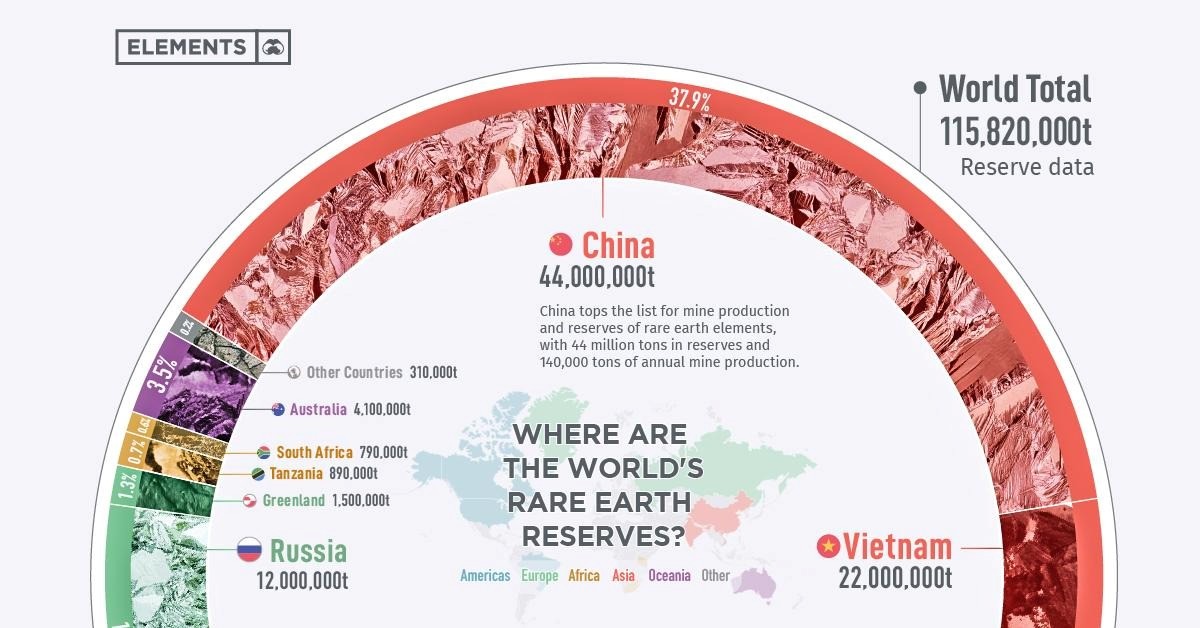
An analysis by Dr. Chester Cabalza (IDSC – Philippines) points out that Vietnam possesses the world’s second-largest rare earth reserves, while Myanmar ranks fourth; meanwhile, Indonesia, Malaysia, and the Philippines hold significant critical minerals directly linked to electric vehicle manufacturing and high-tech industries.
Malaysia has already developed large-scale processing capabilities — a “bottleneck” that most other countries still lack. Indonesia and Thailand continue to strengthen their position as the world’s key producers of nickel and tin — essential raw materials for electric vehicle batteries.
These developments show that Southeast Asia is not only a region rich in resources but is also gradually gaining an advantage in higher-value stages of the global supply chain.
Rare earths – ASEAN’s new “bargaining tool”
Indonesia is leveraging rare earths as a bargaining factor in its trade relations with the United States, aiming to reduce tariffs and address a trade deficit of USD 17.9 billion. Malaysia has also adopted a more open stance toward Washington to attract investment in processing industries.
The Philippines — once indirectly exporting raw materials for China’s supply chain — is now actively repositioning itself to avoid “selling off” its strategic resources.
These moves reflect ASEAN’s new approach: not exploiting rare earths as raw commodities, but as geostrategic assets that provide leverage in economic negotiations.
Cooperation – Competition: The “dual game” of the rare earth supply chain
Thailand — the world’s sixth-largest rare earth producer — aims to become a regional hub for processing and recycling. The country emphasizes that rare earths are the “oil of the 21st century” in the transition toward clean energy.
An article on WGI.WORLD assesses that ASEAN may adopt a model of “coordinated competition” with China — both leveraging China’s investment and technology while also seizing opportunities to strengthen ties with the U.S., Japan, Australia, and the EU.
The biggest challenge is how to avoid being locked into the role of raw material supplier, while processing and manufacturing — where the highest added value is created — remain largely dominated by China.
Moves such as Malaysia expanding cooperation with Lynas Rare (Australia) are positive signals for a multi-centered supply chain that gradually reduces dependency.
A new geoeconomic hub is emerging
Rare earths have become a measure of economic role in the high-tech era. With resource advantages, a rapidly growing consumer market, and a strategic geopolitical position, Southeast Asia is well-positioned to shape a larger role in the global value chain.
However, experts warn that opportunities come with risks: without a comprehensive strategy, the region may fall into a cycle of unsustainable exploitation or unnecessary competition among ASEAN member states.
To maximize long-term benefits, a coordinated regional framework is needed — including standardized regulations for extraction and processing, mechanisms for technology sharing, and selective investment attraction.
Rare earths can become a foundation for elevating ASEAN’s geoeconomic influence, if countries shift from a resource-extraction mindset to a supply chain – technology – security mindset. The race is not just about mining, but about securing control over the future of global strategic industries.
WHAT ARE RARE EARTHS? WHERE ARE THEY USED?
What are rare earths?
- A group of 17 special metallic elements in the periodic table
- Called “rare earths” because they are dispersed, difficult to refine, and costly to process
- Although not scarce in natural reserves, the extraction and processing technology is what creates their strategic value
Where are they used?
- They are core materials for high-tech industries and defense.
Used in the production of:
- Permanent magnets for electric vehicles and wind turbines
- Semiconductors, lasers, and 5G telecommunications equipment
- Energy storage batteries, displays, speakers, and phone cameras
- Military equipment: radars, guided missiles, and electronic warfare systems
Why are they strategic?
- Irreplaceable in green technologies and defense
- Highly concentrated global supply → easily used as a geopolitical leverage tool
- Whoever controls rare earths holds the advantage in future industries
Source: Compiled by the Multilateral Trade Policy Department, Ministry of Industry and Trade of Viet Nam