


Tổng số bài đăng 491.
According to a study by the consulting firm The Boston Consulting Group (BCG), the multipolar world characterized by the polarization between the West and the East is one of the five major trends ASEAN should consider as it moves towards the ASEAN Economic Community 2045 Vision. The polarization, with the West led by the U.S./EU and the East spearheaded by China, is creating global tensions and the emergence of distinct economic ecosystems in fields such as technology, finance, trade, and human resources. This trend presents intertwined opportunities and challenges, requiring ASEAN to act promptly and effectively.
The era of globalization and international cooperation
From the 1990s to the late 2010s, globalization was the dominant trend in the international landscape. Economic, cultural, and human resource integration was driven by a global order that prioritized connectivity, with geopolitical risks receiving minimal attention. However, since the late 2010s, increasing tensions between Eastern and Western powers have led to a more fragmented world. This is evident through economic and technological decoupling efforts between the U.S. and China, as well as conflicts in the Middle East and Eastern Europe.
The rise of emerging economies
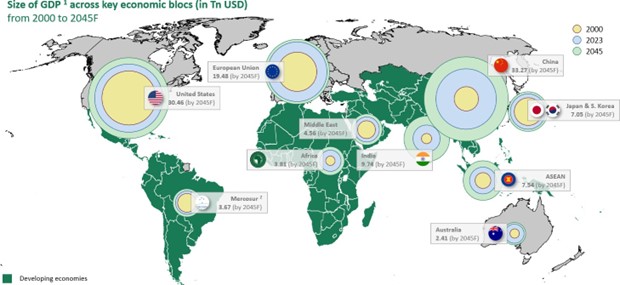
Alongside the confrontation between major powers, a structural shift in the global order is quietly unfolding. Emerging economies, particularly the BRICS group (Brazil, Russia, India, China, and South Africa), are increasingly asserting their roles. Following the addition of five new members in 2024, BRICS now accounts for 25% of global GDP, 40% of global trade, and nearly half of the world’s population.
By 2045, it is forecasted that Southern Hemisphere nations will comprise 52% of the global economy, with China surpassing the U.S. in nominal GDP and India increasing its economic share from 3% (2022) to 7% (2045). Meanwhile, traditional economies such as Europe and Japan are expected to see their roles decline, with Europe’s share dropping from 24% to 19% and Japan’s from 5% to 3% during the same period.
Impact of polarization across sectors
Polarization between the West and the East affects not only geopolitics but also causes fragmentation in technology, finance, trade, and human resource mobility:
- Technology: Technology-related tensions have escalated, as major powers prioritize isolated systems. For example, the U.S. banned Huawei equipment in critical infrastructure due to concerns over Chinese government interference, rather than focusing on global 5G connectivity.
- Finance: Geopolitical risks have prompted investors to tighten control over cross-border capital flows. During the peak of U.S.-China tensions, cross-border investment fell by 15%. Major geopolitical blocs are increasingly influencing capital flows, creating barriers to global financial development.
- Trade: Protectionist policies are on the rise as nations prioritize domestic industries. For instance, the U.S. imposed high tariffs on Chinese imports as part of its broader trade war strategy to promote domestic manufacturing rather than relying on global value chains (GVCs).
- Human resource mobility: New labor restrictions have hindered knowledge-sharing and collaboration in emerging industries. For example, the EU and the UK imposed new work permit requirements after Brexit, complicating labor mobility between the two regions.
Shifts in global power and ASEAN’s role
The shift in global power from the West to the East requires countries like ASEAN to realign their strategies. Deep cooperation with both traditional powers and emerging economies will be key for ASEAN to maintain its position in a polarized world.
In the current context, polarization not only creates tensions but also undermines global cooperation mechanisms. With shifts in economic and technological power, countries must adapt swiftly to ensure long-term benefits in an increasingly divided world.
ASEAN must adjust its strategies to adapt to the global power shift and secure its position amid East-West polarization. Economically, ASEAN should expand partnerships with emerging economies while reducing dependence on traditional partners and positioning itself as a global manufacturing hub. Politically, the region must maintain a neutral stance, strengthen its role in international organizations, and foster internal cohesion to avoid fragmentation.
In technology, ASEAN needs to invest in digital infrastructure, promote innovation, and build an autonomous technological ecosystem to reduce dependence on major powers. Finally, enhancing the quality of human resources through education, training, and increased labor mobility within the region will be crucial for seizing development opportunities.