


Total number of posts 495.
The ASEAN Capital Markets Forum (ACMF), Sustainable Finance Institute Asia (SFIA), and the UNEP Finance Initiative (UNEP FI), have released a White Paper to address the massive adaptation finance gap, with developing countries needing up to USD 365 billion annually. The paper sets the foundation for the forthcoming Adaptation for Resilience (mARs) Guide, which will provide the clarity needed for financial institutions to channel capital into climate resilience activities, supporting Environmental Objective 2 of the ASEAN Taxonomy.
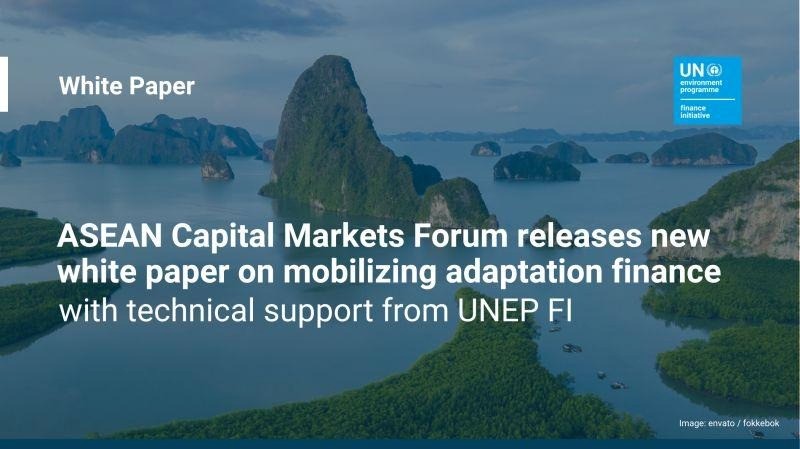
Against the backdrop of intensifying climate pressures reshaping economic decision-making across Southeast Asia, the ASEAN Capital Markets Forum (ACMF), Sustainable Finance Institute Asia (SFIA), and the UNEP Finance Initiative (UNEP FI) have officially released a new white paper laying critical groundwork for regional adaptation finance. This initiative is backed by technical and financial support from the EU Sustainable Finance Advisory Hub (EUSFAH) with the aim of strengthening credible, interoperable sustainable finance frameworks globally.
The release of this document arrives at a critical moment when adaptation finance remains one of the weakest links in global climate spending. According to UNEP’s latest Adaptation Gap Report, developing countries will need between USD 310 and 365 billion annually by 2035 to protect people and infrastructure, yet current international public flows into this sector stood at only around USD 26 billion in 2023. This shortfall is particularly acute for ASEAN economies, home to nearly 700 million people who are already bearing the economic consequences of delayed investment. To address this, the white paper serves as the first phase in developing the mitigation co-benefit and Adaptation for Resilience (mARs) Guide, designed as a vital companion supporting Environmental Objective 2 of the ASEAN Taxonomy for Sustainable Finance.
The core purpose of the white paper and the forthcoming mARs Guide is to help financial institutions, regulators, and issuers identify and evaluate adaptation-aligned activities with the level of clarity already available for climate mitigation. Regional stakeholders have long called for deeper, sector-level guidance to integrate resilience criteria into investment decisions, product design, and reporting. Responding to this need, the white paper identifies points of convergence among national adaptation priorities to form a shared regional baseline and outlines proposed principles for the mARs Guide that are science-based, locally relevant, and compatible with international frameworks.
Commenting on the significance of this step, Eric Usher, Head of UNEP FI, noted that the white paper is a critical step in building the foundations for adaptation finance in ASEAN, helping align financial flows with resilience outcomes so capital markets can play their part in safeguarding communities against climate risks. Echoing this sentiment, Eugene Wong, CEO of SFIA, emphasized that mitigation efforts must be supported by adaptation action as climate change impacts intensify. He added that, guided by the principles set out in the white paper, the mARs Guide will be developed to help providers and users of finance identify the technologies and approaches needed to achieve a paradigm shift for resilience.
The development process will continue through 2026 and 2027, with upcoming phases led by the SEC Philippines and the Monetary Authority of Singapore during their respective ACMF chairmanships. These next steps will focus on translating principles into operational guidance, including tools and decision-criteria that financial institutions can deploy at scale, with the long-term objective of building a financial system capable of directing far larger volumes of capital toward reducing vulnerability and supporting sustainable growth across the region.
Source: Compiled by the Multilateral Trade Policy Department, Ministry of Industry and Trade of Viet Nam