

Total number of posts 479.
Indonesia is determined to continue trade negotiations with the United States despite facing a 32% tariff imposed by President Trump, while also seeking alternative markets in the BRICS bloc and the Gulf Cooperation Council (GCC) countries. Although Indonesia has committed to purchasing American goods and enhancing strategic cooperation, experts believe the likelihood of gaining concessions from the U.S. is low due to Indonesia’s limited bargaining leverage. While BRICS cannot immediately replace the U.S. in terms of industrial goods consumption, Indonesia remains focused on diversifying its markets and expanding exports in the medium to long term.
Indonesia has announced it will persist in pursuing trade negotiations with the U.S., despite President Donald Trump’s decision to impose a 32% tariff on goods from the country. The U.S. action is part of a series of unilateral trade measures applied to 14 countries and will take effect on August 1, 2025. After initially announcing the reciprocal tariffs in early April 2025, Trump extended the deadline by 90 days to allow time for negotiations. During this period, Indonesia showed goodwill by committing to purchase $34 billion worth of American goods, streamlining import procedures, and proposing cooperation in strategic minerals. However, on July 7, President Trump sent a letter to Indonesia annoucing the decision to implement the 32% tariff on Indonesian imports.
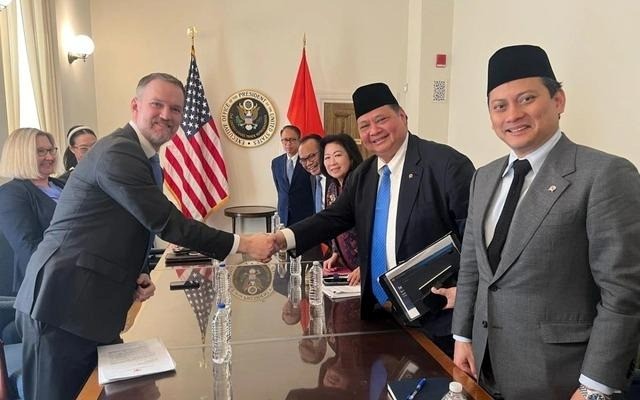
In response, the Indonesian government reaffirmed its intention to make the most of the negotiation window to safeguard national interests. Coordinating Minister for Economic Affairs Airlangga Hartarto traveled to Washington, D.C., after attending the BRICS Summit in Brazil. In the U.S., Mr. Airlangga witnessed the signing of several Memoranda of Understanding between Indonesian businesses and American partners, including agreements to purchase LPG, gasoline, crude oil, and corn from American corporations.
Nonetheless, analysts assess that the chance of successful negotiations remains very low. According to economists from the Center of Reform on Economics Indonesia (CORE) and the Institute for Development of Economics and Finance (INDEF), Indonesia currently lacks sufficient leverage to influence the Trump administration’s decisions. The U.S. might only consider reducing tariffs if Indonesia or its companies invest in production facilities in the U.S. or offer concrete economic, political, or security concessions. Some experts also suggested that Indonesia could seek exemptions through the Generalized System of Preferences (GSP), although this is considered unlikely under Trump's leadership.
Facing U.S. pressure, Indonesia is also intensifying efforts to find alternative markets, especially among BRICS members and Gulf Cooperation Council (GCC) countries. At the BRICS Summit, President Prabowo Subianto urged member countries to increase imports from Indonesia and proposed a South–South Economic Agreement initiative to enhance market access for developing nations. He also called for the swift conclusion of the Indonesia-GCC Free Trade Agreement in a meeting with Saudi Crown Prince Mohammed bin Salman.
However, experts believe that BRICS countries cannot substitute the U.S. in the short term, as most of them remain focused on raw material trade, while the U.S. serves as a major market for labor-intensive industrial products such as textiles, electronics, and furniture. Still, in the medium term, if Indonesia can diversify its product range and reach the growing middle class in India and China, its export potential could improve. Moreover, leveraging South Africa as a transshipment hub into Africa is seen as a strategic direction.
Overall, Indonesia finds itself in a challenging position amid U.S. protectionist trade policies but remains committed to negotiations and proactively seeking new opportunities. To achieve long-term balance, the country must develop an export strategy centered on market diversification, value-added investment, and greater integration into regional and global supply chains.
Source: Compiled by the Multilateral Trade Policy Department, Ministry of Industry and Trade of Viet Nam