

Total number of posts 495.
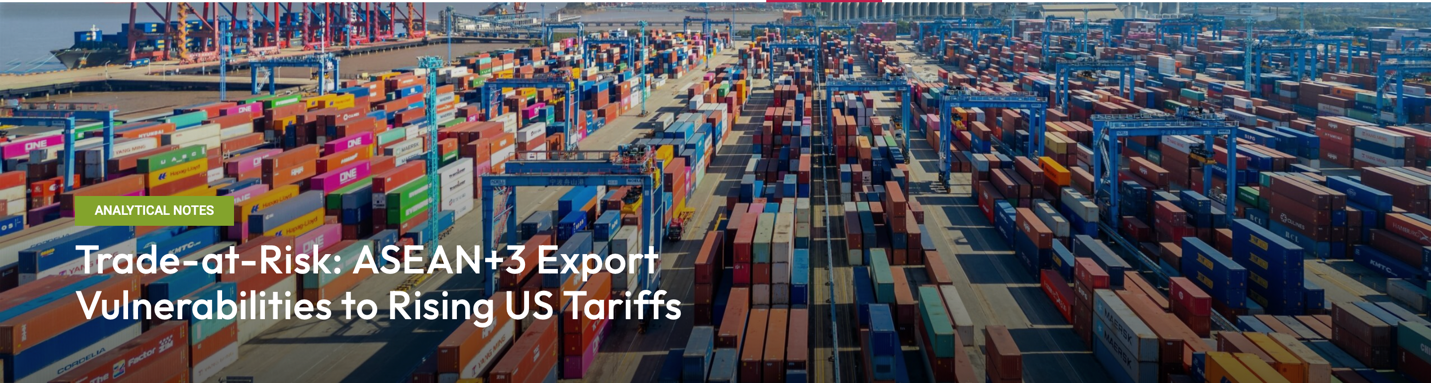
A team from the ASEAN+3 Macroeconomic Research Office (AMRO) published the report “Trade-at-Risk: ASEAN+3 Export Vulnerabilities to Rising US Tariffs” in November 2025 to assess the risks that ASEAN+3 economies (ASEAN plus China, Japan, and South Korea) face under U.S. tariff policies. The report constructs a novel “trade-at-risk” indicator, which integrates product-level trade elasticities with both direct and indirect export exposures—including the domestic value added of exporting sectors and global value chain (GVC) linkages. The report notes that while the overall vulnerability of the region remains moderate compared to other major trading blocs, there is significant heterogeneity across economies and sectors.
Source: AMRO
1. Background
For many years, exports to the U.S. have been an important driver of economic growth for many ASEAN+3 countries. However, since early 2025, the U.S. has implemented global-scale tariff policies, including additional duties on a variety of goods imported from China and other Asian countries. These U.S. tariff measures and increasing uncertainty have affected trade flows between ASEAN+3 and the United States.
A notable recent trend is that multinational companies are adopting a “China+1” strategy, shifting part of their production chains from China to neighboring economies. While this strategy helps diversify production bases, it also increases ASEAN+3 countries’ dependence on the U.S. market (excluding China).
2. Product-level trade vunerabilities
Consumer goods with high substitutability (e.g., furniture, footwear, clothing, toys) are considered high-risk. These products represent a small share of U.S. consumer spending and are highly sensitive to price or tariff changes. If prices rise due to tariffs or U.S. consumer spending declines, these goods can easily lose market share, directly affecting ASEAN export revenues.
Intermediate industrial goods and high-tech components (e.g., semiconductors, electronic components, rare metals) face lower risks. These goods are essential in global production chains, making immediate substitution difficult, and demand remains relatively stable.
Goods with moderate price elasticity (some industrial materials, semi-finished products) face medium risk, depending on supply chain adaptability and availability of alternative markets.
3. Indirect impacts through global value chains
The report emphasizes that export risks are not limited to final products but also propagate through GVCs. When exports to the U.S. decline, economies supplying materials or components to affected countries also face indirect impacts. This means that some ASEAN+3 countries, even with limited direct exports to the U.S., can still be vulnerable if they are part of the supply chains of highly exposed countries.
4. Vulnerabilities by country and sector
Export vulnerability is uneven across ASEAN+3 countries. Economies focused on easily substitutable consumer goods face higher risk due to heavy reliance on U.S. consumer spending and the ease of substituting these products. Conversely, countries exporting intermediate industrial goods, components, and high-tech products (such as China, South Korea, and Japan) have lower risks, owing to the importance of these products in supply chains and stable demand. The report also notes that differences exist not only between countries but also across sectors, depending on the technical characteristics and significance of each product within GVCs.
5. Conclusion
ASEAN+3’s reliance on trade integration with the US is becoming a source of vulnerability as US trade policy becomes increasingly unpredictable. While the trade-at- risk clusters show that ASEAN+3 countries are not all highly susceptible to US trade policy actions as in the case of Canada and Mexico, several ASEAN+3 economies face moderately higher risks than others due to their larger dependence on the US market, a more elastic product mix of their US-bound exports, and/or the higher domestic value added of their exports to the US.
For economies with high direct exports to the U.S., reduced U.S. demand—especially for products with higher trade-weighted elasticities —can lower exports. Economies indirectly connected to the U.S. via GVCs, such as Indonesia and the Philippines, will also experience negative spillovers if U.S. demand weakens.
Export structure matters: countries with exports concentrated in certain sectors or products sensitive to tariffs, such as Cambodia (textiles) or Japan (automobiles), are more vulnerable. Diversifying exports is therefore a key strategy to mitigate risks, especially for economies heavily dependent on the U.S. market./.
Source: Compiled by the Multilateral Trade Policy Department, Ministry of Industry and Trade of Viet Nam