


Total number of posts 491.
Australian lychees have begun entering the Vietnamese market toward the end of the year, when the domestic harvest season has finished. Retail prices at specialty fruit shops are currently around 800,000 VND per kilogram, equivalent to 4 million VND for a 5-kilogram box.
A fruit shop in Nha Be District reported receiving about 30 boxes of Kiamana lychees, a variety that accounts for a significant share of Australia’s commercial lychee production. As Australian supply is more abundant this year, import prices to Viet Nam have fallen by about 20 percent compared to the same period last year. However, these lychees still cost far more than Vietnamese in-season varieties such as Luc Ngan (Bac Giang) or Thanh Ha (Hai Phong) lychees, which typically range from 20,000 to 80,000 VND per kilogram.
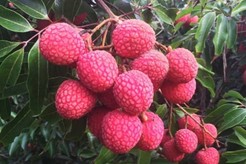
Image: Australian Lychee
Kiamana lychees feature a deep red peel, small seeds, thick flesh and a light, sweet flavor. The fruit is harvested with stems attached, transported by air and packaged directly in Australia. According to retailers, this process helps maintain freshness upon arrival in Viet Nam.
At another imported-fruit shop in Binh Thanh District, the owner noted that large-sized Kiamana lychees are usually priced about 100,000 VND per kilogram higher than medium-sized ones. The shop has already sold more than 100 boxes since the start of the season and plans to import two additional batches before Australia concludes its harvest. Due to the fruit’s short shelf life, retailers only import several dozen boxes per shipment and distribute them based on local demand to reduce spoilage risks.
Australian lychees appear in Viet Nam during the year-end period because of differing harvest calendars between the two countries. Viet Nam harvests lychees from April to July, while Australia’s season runs from November to January. In Australia, premium lychees sell for around 80 USD per 5-kilogram box, equivalent to over 2.1 million VND, reflecting high production costs and strict quality standards in Queensland, the country’s main lychee-growing region.
Australia has around 250 lychee growers and more than 40 varieties under development, roughly half of which are grown commercially. Kiamana is the most commonly exported variety to Viet Nam. Other specialty varieties, such as the large “dragon egg” lychee, appear occasionally but have unstable supply.
According to Viet Nam’s Department of Customs, as of late October, imports from Australia reached nearly 142 million USD, up 9 percent from the same period last year. Under HS code 08109020, Australian lychees enter Viet Nam with a zero-percent tariff under both the RCEP and AANZFTA agreements.
In the opposite direction, Viet Nam shipped its first consignments of fresh lychees to Australia in early 2021, marking an important step in accessing this highly demanding market. The significant price gap between the two markets also indicates potential profit margins for Vietnamese exporters. However, fresh lychees must comply with stringent Australian biosecurity requirements, including irradiation at an approved facility, pesticide residue limits, pest-proof packaging and a full phytosanitary certificate.
In the broader global context, China remains the world’s largest producer and exporter of lychees, with major growing regions in Guangdong, Fujian and Hainan. Key export destinations include the United States, Canada, Europe, Hong Kong, Singapore, Indonesia, the Philippines and Malaysia.
Source: Compiled Information